
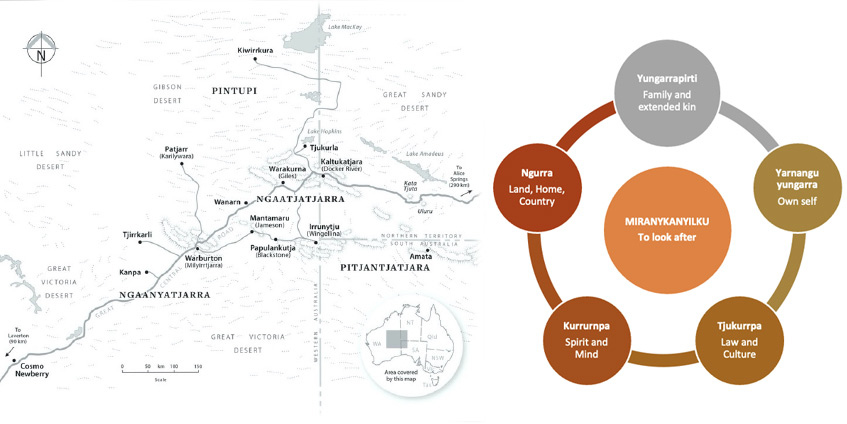
The ‘Ngaanyatjarra Lands’. Cartography © Brenda Thornley 2023 and Yarnangu cultural determinants of health and well-being developed in the study.


“Before in early days we was living on all them meats, no sugar, they was healthy and drinking water. Then this white man came and started to give us new tastes, well that was that sugar now.”
Ngaanyatjarra people (‘yarnangu’) as descendants of the last nomadic groups of Australia’s Western Desert maintain an unbroken connection with Western Desert heritage and culture. In the decades since first contact with settler-colonial society in the 1930s, they have shifted from an independent, self-sustaining society to Western-style living under the influence of external policies. In that time yarnangu health has declined profoundly and poverty is now normalised for yarnangu.
The Tjilku Walykumunu Child Health Study (2021-2023), initiated by the Ngaanyatjarra Health Service, found that families often cannot afford to feed their children: 1 in 3 families always ran out of money between paydays, while only 1 in 4 always had money for essential food and groceries. Child nutrition was found to be the most pressing health issue:
“I really worry for the future because you’re seeing children aged 8, 9, 10, significantly obese, deteriorating blood sugar levels and having Type 2 diabetes.”
Healthcare staff assume that families do not purchase healthy food options because of cost. We confirmed that typical grocery items in community stores cost 69% more than in urban supermarkets. We found, however, that social and cultural and environmental forces, not cost, drive food-purchasing and consumption behaviours.
Ngaanyatjarra society is kin-based, underpinned by the conviction that everyone will ultimately be looked after by someone. Thus, yarnangu only go hungry if there is no food or money in the community. Cultural determinants such as reciprocity and sharing affirm cultural identity; providing a buffer against financial adversity and food insecurity. The protective function of demand sharing is evident; a cultural trait that determines how people purchase and share food. Another cultural trait is the enduring preference for meat. Still today, despite the expense, yarnangu prefer to eat meat, rather than fruit, grains and vegetables as health professionals recommend.
An environmental factor driving food purchasing behaviours is that kitchens may not have functioning fridges and stoves, or even utensils, as one mother described:
“In other houses no stuff, no cooking stuff. I got it, but I got to buy it over and over because it will walk out if I’m not there.”
Hence families spend a lot of money on relatively expensive ‘quick and easy’ foods (tinned foods, noodles, bread), foods that require no refrigeration, can be heated on an open fire or eaten directly from containers.
“When I first started working remote”, stated a nurse, “as the sun went down, kids would gravitate home and someone would be cooking, and if they didn’t have much money they’d be cooking damper, or making a soupy stew ... They’ve still got the skills and the knowledge, but they are living on take-away food or ‘quick and easy’ food.”
The consumption of convenience, or take-away, foods high in fat and sugar providing instant gratification without having to cook is another marker of change. Children are often given money by relatives that they spend primarily on fatty food, or sugar-sweetened food and drink. Curtailing these purchases is difficult in Western Desert society where indulging children and prioritising their needs and wants are considered positive caregiving practices.
Understanding the social and cultural determinants of health is of intrinsic importance to improving health in very remote Indigenous communities. From a public health perspective, policy-making and service design must build from an understanding of cultural identity and lived experience through participatory collaboration with yarnangu.
We thank all Ngaanyatjarra community members for their guidance and participation
Add new comment