


Educational attainment impacts health status and labour force participation. In regional and remote communities, successful delivery of education and training should address issues of access, participation, workforce shortages, and funding models.
Aboriginal and Torres Strait Islander people are less likely to participate at school; this is more prevalent in remote and very remote areas. Completion of school is only 24% among low socio-economic status groups. In very remote areas this is as low as 10%. Most reported secondary education (Year 10 and above) as their highest level of educational attainment.
Our research seeks to use evaluation methodologies including self-report surveys, interviews and focus groups, observational methods, administrative data, and real-time measures to understand how student participation and engagement through the middle years supports sustained increase in Year 12 completions and participation in vocational education and training.
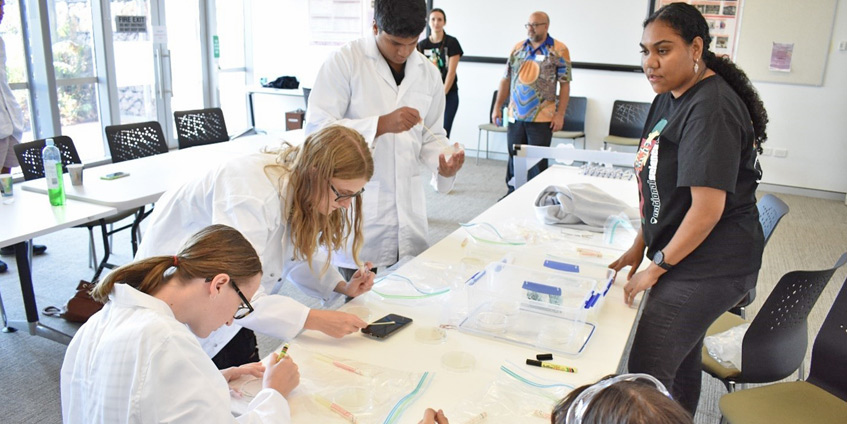
The Menzies-Ramaciotti (Dawudlirra) Centre is a laboratory skills training and health promotion centre dedicated to the development of a sustainable, local and Aboriginal and Torres Strait Islander health workforce in the Northern Territory. The Centre is co-led by Aboriginal and Torres Strait Islander researchers and experts in public health, melioidosis and epidemiology.
The model relies on partnerships between higher education providers, industry, school programs, students and families to meet different levels and types of needs. This includes in-school programs such as Indigenous Allied Health Australia’s Northern Territory Health Academy, SEDA College, Stars and Clontarf Foundations that support Aboriginal and Torres Strait Islander Year 12 completions and foundational interests in biomedical and health vocations.
What is unique about the Centre is that it provides an environment where trainees feel safe to receive practical skills and qualifications while creating opportunities to network with like-minded peers. This is a critical point of difference for student participation and engagement. Linking trainees with industry leaders builds their confidence and access to professional networks.
As expressed by a Menzies-Ramaciotti (Dawudlirra) Centre trainee:
“I’m the first in my family to finish high school, let alone university. Coming here and meeting people at the top of their fields has helped me map my journey.”
In July this year, the Centre’s role in building a culturally safe scientific community was recognised by Larrakia elders. The Centre was gifted the Larrakia name for sea turtle, “Dawudlirra”, which represents wisdom.
Mr Mark Mayo, Menzies-Ramaciotti (Dawudlirra) Centre Co-Lead, reflected,
“The gifting of a Larrakia name is about elevating Aboriginal and Torres Strait Islander culture, part of the DNA of who we are as Australians. We are sharing our culture, and our culture is being embraced by all Australians.”
Engaging students in scientific inquiry at younger ages has led to increased uptake at post-school levels. Since the Centre’s establishment in 2020, over 200 trainees have obtained education and training in biomedical and health vocations. Some have gone on to pursue further studies at university, receiving financial assistance from scholarships and ongoing support from mentors.
Supporting students to undertake training in these areas addresses the complexities in regional and remote communities of equity in education, providing pathways to improved health outcomes, labour force participation and self-determination.
Professor Adele Green, who represents the Ramaciotti Scientific Advisory Committee, said,
“The Centre is outstanding because of the virtuous cycle it engenders. It has gone beyond addressing health outcomes to highlight education as the building block of community.”
Our research explores how the Menzies-Ramaciotti (Dawudlirra) Centre model supports improved and effective transitions for Aboriginal and Torres Strait Islander people in Northern Australia. Increased participation in biomedical and health vocations is critical to building a sustainable health workforce that understands the complex needs of regional and remote communities.
Add new comment