
-
 Arabana Traditional Owners community members and RFDS stakeholders at the opening of the William Creek health hub
 -
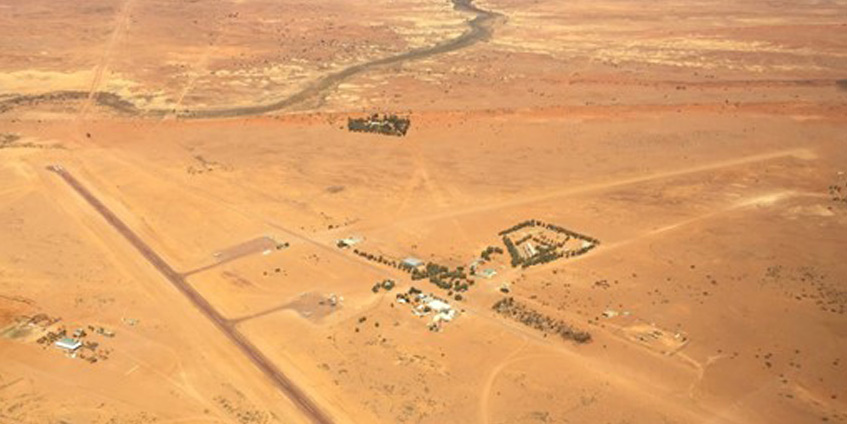 William Creek aerial view. Image: flyingtheoutback.com.au
 -
 Remote doorbell and intercom at the William Creek VEC
 -
 William Creek telehealth kiosk room



Australia's vast geography and rural population distribution pose significant challenges to equitable emergency care. With most healthcare services concentrated in metropolitan areas, remote populations face lower life expectancy and higher mortality risk. Many small communities lack the population density to support full-time health professionals or emergency services. Thus a key challenge is how hospital-grade emergency care can be provided in real time when local healthcare professionals are not available?
Answering this question requires innovative approaches to healthcare delivery, integrating emerging technologies, adapting clinical models, and rethinking response strategies beyond traditional road and air transport.
Virtual Emergency Care: A Case Study
One approach is the RFDS’s Virtual Emergency Centre (VEC) in William Creek, South Australia, which opened in March 2024. This small community, with a population of just 17 but hosting thousands of tourists annually, has long been supported by RFDS clinics for primary care clinics and aeromedical retrieval, but the new VEC offers an innovative model of an unstaffed emergency centre, available 24/7 but managed remotely.
Patients arriving at the VEC are directed to a telehealth kiosk. After contacting the RFDS operations team via intercom, they are admitted to the kiosk, and a doctor dials in for immediate visual assessment with high resolution audio and video, pencil camera for intraoral and zoom views, and vital signs obtained from and transmitted by the telehealth unit to a remote doctor. A first aid kit and digital prescriptions are available if care is not time critical or high acuity, but if immediate intervention is needed, the patient is given access to an adjoining treatment room with a bed, oxygen concentrator and AED, and the local medical chest custodian, trained in remotely supervised oral and IM medication administration and basic life support, can be activated to provide urgent care until a retrieval team arrives.
This model, supported by satellite internet, backup power, and remote IT support, has already demonstrated effectiveness, including successful remote resuscitations and retrieval avoidance.
Remote Diagnostic and Imaging Innovations
Not all communities have the resourcing for a permanent facility, and are reliant on voice assessment over radio or phone, or visual assessment over video link (if data connectivity suffices) from home or a local community facility. The augmentation of telehealth effectiveness requires access to diagnostic devices. The simplest approach, rather than attempting to roll out proprietary devices, is leveraging the commercial sector’s approach to healthcare technology is a cost effective solution for diagnostic augmentation. Devices like Fitbits, Oura rings and other personal health trackers are increasingly accurate and accessible, making it feasible for remote clinicians to better assess remote patients who were previously limited by voice or video assessment. Augmentation of diagnostic accuracy planned via strategic placement of pulse oximetry, digital stethoscopes, ECGs and more within existing medical chest programs, aligning diagnostic and therapeutic resourcing for remote communities.
Remote imaging requires pushing current barriers of expense, training and exposure for remote clinicians. One approach is exploring the feasibility of remote ultrasound by local paramedics or nurses, with real-time remote guidance and interpretation by doctors over video link. Trials in this space are anticipated to commence soon with remote mine and clinic sites in South Australia.
Additionally, RFDS is working with the Australian Stroke Alliance to develop portable brain scanners that can be used in remote areas, sending images to neurologists via satellite for immediate diagnosis and prehospital treatment prior to arrival at a receiving facility. In addition, companies like Micro-X are advancing miniaturized CT scanners using nanotechnology, potentially allowing for broader diagnostic capabilities in remote settings. Though regulatory hurdles remain, these innovations offer exciting possibilities for improving emergency care imaging with timely intervention.
A Vision for Remote Healthcare
What should be our goal for remote Australians? Perhaps it should be high-quality emergency care within an hour for all Australians, regardless of location. This is ambitious but achievable through collaboration across industries and disciplines. With targeted investment and partnerships, we can work towards ensuring that all Australians, no matter where they live, have access to the care they need in a timely, cost-effective, and culturally appropriate manner.
Add new comment