


In a rural school within a lower socio-demographic community, a well-intentioned initiative aimed at improving death literacy faced significant challenges, though it also offered valuable insights. This story underscores the complexities of addressing such a sensitive topic within the educational system, especially in areas where experiences of loss are profoundly impactful.
The project began when a teacher, returning to education after decades in social research and palliative care, noticed a critical need for death literacy in his community. Rural areas often experience early deaths, and the local school had recently been shaken by two tragic events: a student's mother was found deceased on school grounds, and not long after, a student died by suicide. These incidents highlighted the community's difficulty in addressing and processing death, which is frequently sanitised in language as people "passing" rather than dying.
Recognising the need for a generational shift in how death is perceived and discussed, the teacher was inspired by programs such as those run by Calvary Health Care Bethlehem, La Trobe University, and Palliative Care Victoria, which worked with metropolitan schools to bolster community resilience in dealing with death. He also admired the resources for teenagers authored by Molly Carlile. Yet, despite these influences, introducing such a curriculum in a rural school proved to be daunting.
With the support of some fellow teachers and the curriculum committee, the teacher developed an innovative module for Year 9 students, hosted on the Stile platform. This module included eight lessons featuring songs, videos, and interactive media, all designed for face-to-face interaction. Initially, the response was mixed; while there was some parental gratitude, the program faced interruptions from COVID-19, leading to its suspension due to concerns about delivering it effectively without consistent in-person engagement.
The interruptions and the remote nature of the community ultimately stymied the program's momentum. The curriculum was never fully integrated, and a planned evaluation could not be conducted. The teacher, perceived as an expert, found it difficult to train other teachers, who were hesitant to engage with such a sensitive subject matter.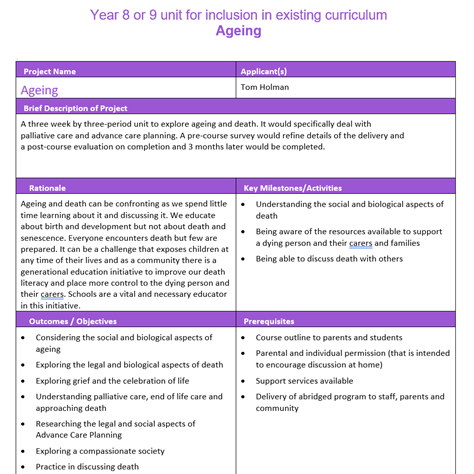
Despite these setbacks, there were notable successes. One particularly poignant moment involved a student initiating a conversation about death with her mother, suggesting the potential for meaningful family engagement on this difficult topic.
For rural communities, where the stakes are uniquely high due to isolation and limited access to services, the need for continued dialogue and education about death and dying remains critical. The journey of this initiative, while fraught with challenges, underscores the importance of persistence and community involvement in fostering resilience and understanding around life’s most difficult conversations.
Add new comment