


A close connection to both community and the land makes people in regional and remote communities consider the country a more contemplative setting to die, rather than at metro-based services.
In the last three years, Murray PHN’s The Caring Circle project has focused on working with communities in the Hume region to develop death knowledge and skills. Centred on the values of humanism and compassion, the project aims to improve the quality of life and death of people living in the country, and whenever possible, to be surrounded by those important to them.
How innovative ideas can strengthen existing community connections:
The journey of those living with dementia
In partnership with Dementia Australia, Murray PHN hosted two Introduction to Dementia sessions in Shepparton and Wodonga earlier this year, attracting 45 participants. The face-to-face sessions provided an opportunity to build awareness while connecting community members experiencing similar journeys – an important aspect of palliative care.
Discussing the important aspects of living in communities
Dying to Know Day is an annual event each August that aims to break down stigma and discomfort around talking about death, dying and grief. As part of the event’s activities, Murray PHN partnered with the Hume Specialist Palliative Care Consortium to deliver the Good2Go Festival in Wangaratta. The festival offered a series of activities including “death cafes”, presentations, movie showings and exhibitions to discuss the most important aspects of living. Held over four weeks, the festival attracted communities from Wangaratta and across North East Victoria.
Improving information access for people living with an end-of-life condition
As deaf and hard of hearing communities experience poorer health outcomes in comparison to hearing populations, Murray PHN and Deaf Hub Bendigo developed Auslan-translated resources on palliative and end-of-life care. These are now available to bridge this gap of access to information in the Victorian Department of Health’s Health translations directory.
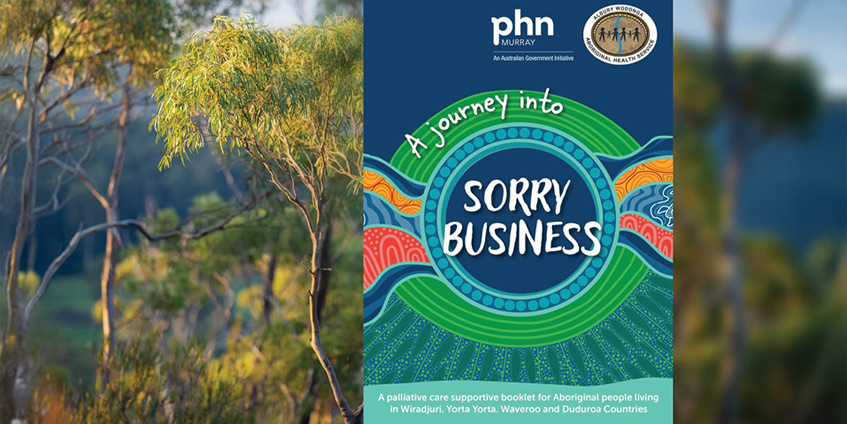
A Journey into Sorry Business supports First Nations people and their carers in understanding more about palliative care and local services. This free, easy-to-read booklet has been created to provide culturally appropriate, respectful and mindful information to encourage Aboriginal people to yarn about their rights, wishes and how to plan ahead when circumstances change through their lives. The booklet can be downloaded from https://bit.ly/4eKWFi9
Supporting those caring for people dying in community
More than 2.65 million Australians (one in 10) are carers. In Victoria, carers provide more than 40 hours of unpaid care per week (Carers Australia, 2021). Murray PHN has commissioned GV Hospice, a community palliative care service in Shepparton, to deliver a wellbeing pilot program for carers of people at their end-of-life.
The End-of-Life Carers Support Program was designed after extensive consultation with carers in the Goulburn Valley region. It offers weekly sessions where carers can discuss life, death and everything in between over a cuppa, followed by a wellbeing activity to support connection. By June 2024, six wellbeing sessions had been held for more than 20 local carers. Activities ranged from information sessions on local services available to carers, wellbeing and social activities such as tai chi, therapy dog visits, art therapy, and trips to local museums and community centres.
Further strategies will continue and be expanded next year. For more information, visit www.murrayphn.org.au/thecaringcircle
Add new comment